Why do 31% of table games players in the US prefer to play blackjack, according to industry estimates? This game is simple to understand and play. Your role in blackjack is to beat the dealer to 21 without going bust. It’s just that simple! If you’re a beginner, blackjack is the perfect game for you.
Moreover, you can find it at any social casino, in various variations. In addition, it offers more favorable odds than other casino games, increasing your chances of winning.
But how do you play blackjack? Knowing how to play the game can increase your odds of winning. This guide will show you how to play blackjack and give you tips to win big.
Let’s begin.
Blackjack Basics: How the Game Works
Some people have the wrong idea of how to play blackjack at a casino. But all that you’re trying to do is to beat the dealer. Here’s how to beat the dealer:
- Get a hand value that is higher than the dealer's.
- Watch for a hand value over 21 to be drawn by the dealer.
- Draw a hand value of 21 on your first two cards when the dealer doesn’t.
You can lose to the dealer when:
- Your hand value exceeds 21.
- The dealer's hand has a higher value than yours when the round ends.
Remember that other players' hands at the table don't affect how you win blackjack, unlike in online poker. You and the dealer are competing against one another in this game. It’s you and the dealer alone.
How a Round of Blackjack Plays Out
You can play blackjack games with various deck counts, and they come with numerous rules. The typical variation you can play is with 6 or 8 decks and a "shoe" (a plastic card dispenser).
You can still play single and double-deck games, but they are less common than "shoe games." Here's how to play casino blackjack with 6 decks:
Place Your Bet
If you want to learn how to play blackjack at home, the first step is to place a bet in the betting circle when a round begins. Search for a small sign on the far left or right of the table to find the betting limits. Most online casinos in the U.S. have a $5 minimum bet per hand. However, the exact minimum and maximum bets may be subject to local laws and the casino.
You Get Cards from the Dealer
After placing your bet, the dealer starts dealing cards clockwise. First, the dealer gives each player one card face up at the table. Then, the dealer deals herself one card face down and another card face up. So, each player will have two cards face up in front of them, while the dealer will have one face up and one face down.
Choose How You Play Hand
If you want to know how to play blackjack online for real money, you must decide how to play the hand. The player on the dealer's left, called the first base, plays their hand first, followed by the dealer. Two cards are face up in front of your wager. Add the card values to get a number between 4 and 21 to play your hand.
You have a blackjack if your first two cards are an Ace and a card worth 10 or more. If the dealer doesn't have a blackjack that pays 3 to 2 immediately without requiring you to finish the game, you should stand. If the dealer also has a Blackjack, it’s a "push." This means neither you nor the dealer will win or lose your initial wager.
Dealer Plays Hand
When the dealer's face-up card is visible, you can quickly determine which option is better using the blackjack basic strategy. This strategy can help you consider your hand and the dealer’s card to improve your chances of winning.
So you don't need to do any guesswork on how to play blackjack. This strategy makes it easy to learn and improve your skills. To improve your skills, you can play the demo version and practice the blackjack strategy before playing for real money. So use the blackjack strategy to learn how to play and win at blackjack.
Blackjack Card Values & Scoring
Understanding blackjack card values is the starting point for everything else in the game. Every decision you make — hit, stand, double down, split — flows from knowing what your hand is worth and what the dealer might be holding.
Here's how every card in the deck scores:
|
Card |
Value |
| 2 through 9 | Face value (2 = 2, 7 = 7, etc.) |
| 10, Jack, Queen, King | 10 each |
| Ace | 1 or 11 — whichever helps your hand more |
The Ace is the most important card to understand. If you hold an Ace and a 6, your hand is either 7 or 17. That's called a soft hand — the Ace counts as 11, but it can drop to 1 if taking another card would push you over 21. A hand with no Ace, or one where the Ace can only count as 1 without busting, is called a hard hand.
Key scoring thresholds to know:
- 21 on your first two cards (an Ace plus any 10-value card) = Blackjack. Pays 3:2 in most variants.
- Bust = any hand over 21. Automatic loss regardless of what the dealer holds.
- Push = you and the dealer finish with the same total. Your original bet is returned.
- Soft 17 = Ace + 6. Dealers are often required by house rules to hit on soft 17 — this affects your strategy decisions.
Knowing these blackjack card values and hand types cold before you play is what separates players who make reactive decisions from those who play with a clear plan.
When to Hit, Stand, Double Down, or Split
This is where blackjack basic strategy becomes practical. Each of your four main options has a mathematically correct application based on your hand total and the dealer's face-up card.
Hit — take another card from the dealer. Use when your hand total is low enough that the risk of busting is outweighed by the risk of the dealer beating your current total. General rule: always hit on hard 8 or below. Hit on soft hands (Ace-low) when the total is 17 or below unless conditions below apply.
Stand — keep your current hand and end your turn. Use when your hand is strong enough that hitting risks a bust, or when the dealer is likely to bust. Always stand on hard 17 or above. Stand on hard 13-16 when the dealer shows 2 through 6 — the dealer is in a bust-prone position and you benefit from staying put.
Double Down — double your original bet and receive exactly one more card. Best used when you're in a strong position and one more card is likely to help. The highest-value double down is on a hard 11 against any dealer card except an Ace — you can't bust with the next card, and a 10-value card brings you to 21. Also strong: hard 10 when the dealer shows 2 through 9, and soft 16-18 in certain dealer-card situations.
Split — when your first two cards are a matching pair, you can split them into two separate hands, each with its own bet. Always split Aces — two separate hands starting with an Ace are significantly stronger than a combined total of 2 or 12. Always split 8s — a hard 16 is one of the weakest hands in blackjack; two hands starting at 8 each give you better positions to work from. Never split 10s — a 20 is a near-winning hand; splitting it throws away a strong position. Never split 5s — use that 10-value total to double down instead.
These decision rules form the core of blackjack basic strategy and apply consistently across standard variants. Learning them removes the guesswork from how to play blackjack and cuts the house edge to its minimum.
What is the Blackjack Basic Strategy Chart
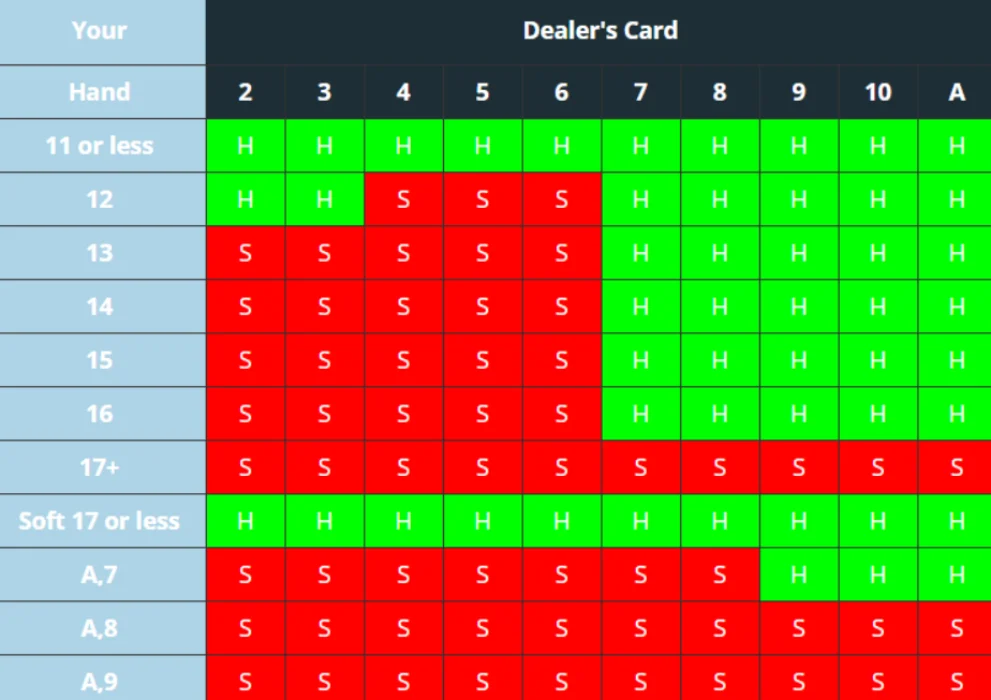
Learning to use the blackjack strategy table will give you a significant advantage over the house. These tables detail the best actions to take with the standard blackjack strategy.
The rows and columns include essential information to help you play the game and increase your chances of success.
Based on your hand and the dealer's upcard, the tables below will help you decide whether to hit, stand, double down, split, or surrender. Blackjack strategies change depending on the number of decks in play.
So it's crucial to remember that you can't just apply one chart for all games. The most fundamental blackjack techniques apply to both two- and four-deck games. Using an 8-deck chart in a double-deck blackjack game reduces your risk of losing your entire bankroll.
But does nothing to increase your chances of winning. So, before you jump into a game, make sure you know the rules and can memorize them.
How to Read a Blackjack Basic Strategy Table
Once you've mastered blackjack's fundamentals, learning and committing any given strategy chart to memory is simple. These tables detail the optimal moves based on your hand and the dealer's.
Your hand value will be displayed in the left column, while the top half of the chart will reveal the dealer's probable upcards. You can decide whether to hit, stand, split, or double down by locating where these lines connect.
Learning the chart by heart can make your time more enjoyable and win you points with the dealers. So, becoming comfortable with the chart will increase your self-confidence and improve your chances of winning.
What to Know Before Memorizing Blackjack Charts
Blackjack is a game where talent, knowledge, and experience are essential. While visual charts and tools can be useful, they are no guarantee of success. Use them as a springboard to create your unique strategy. Before you try to memorize blackjack charts, take into account the following:
Basic Strategy has Limitations
Understanding the core plan is crucial, but not enough to ensure long-term success. You'll need to improve your blackjack basic strategy and investigate new ways to beat the house edge. This is crucial if you want to increase your chances of winning.
Charts Vary with Game Variations
Your initial, simplified chart will change as you play several versions of the game, each with its unique rules. As you gain expertise with each game variant, you must modify the chart, add or delete particular parts, and design a new layout.
Memorizing Charts Precisely is Essential.
To improve your skills and strategy, you must commit every possible scenario to memory and make it a natural part of your play. Getting a high level of expertise at blackjack takes practice and patience. Consistent practice is the best way to learn the ins and outs of the game. Learning the charts will make it easier to make tough calls when playing blackjack. Also, read bitcoin blackjack tips guide if you are planning to play this amazing game at a crypto casino.
How to Play Blackjack and Win: Tips to Improve Your Winning Odds
If you want to know how to play online blackjack, remember you’ll have to deal with the house edge. If not, you’ll have a higher chance of losing, especially if you’re a beginner player. However, you can use several strategies to improve your odds of winning and increase your cash winnings! Here are some tips to help you learn how to play online blackjack and win:
Choose the Online Casino
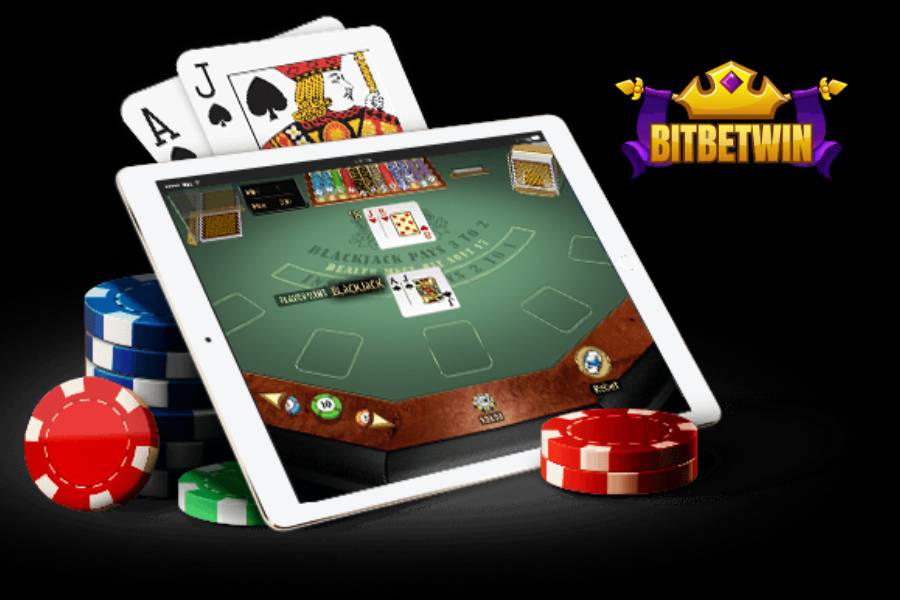
It can be challenging to find the best online casinos. However, with some research, you can find the right casino platform and its minimum stakes. You can register with BitBetWin, one of the best platforms in the casino industry.
You can play all the blackjack variations and use the demo version to practice before playing for real money. This is an excellent option if you want to know how to play casino blackjack without risking your bankroll.
BitBetWin offers numerous online casino promotions and bonuses to help you play for free and win cash prizes. In other words, you can learn how to play blackjack online for real money.
Set a Budget and Stick to It
Before you learn how to play blackjack at a casino, decide on a budget limit. Use the money you can lose without affecting your livelihood. And stick to it, regardless of the game's outcome. If you see that you’re losing many times, don’t chase your losses. Stick to your initial decision and stop playing the game. It’ll save you from overspending your budget. You can stop playing and come back later. So, stay disciplined and play within your budget.
Develop a Betting Strategy
If you want to know how to play blackjack 21 and improve your chances of leaving the table with more cash, develop a betting strategy. You can use the Martingale and Paroli betting systems. These betting strategies rely on mathematical progressions to reduce losses and increase profits. These strategies can help you, but you need a specific bankroll. These blackjack strategies may not be for you if you have limited funds.
Double Down on Hard 11 Hands
When you are doubling down in blackjack, you double your bet but get only one more card. You should double down if you have a hard eleven and can't go bust no matter what cards are dealt. This action is taken in the hopeful expectation of receiving a face card. And that would increase the total to twenty-one, or an ace, which would decrease the total to twelve. When you double down on hard eleven, you place a probability-based wager on a positive outcome.
Use the Blackjack Strategy Chart
The blackjack basic strategy chart can help you determine what to do in different situations. The strategy covers many topics, including how to hit, stand, double down, divide pairs, and surrender. You should memorize and regularly consult this strategy table to increase your chances of winning.
Pick the Tables Where the Dealers Always Stand on 17
In blackjack, soft hands are those with an ace that can be counted as either 1 or 11. Playing at tables where the dealer stands on soft 17s boosts your odds of winning. And that's because the dealer's hand is stronger when the dealer has a soft 17 (where the ace counts as 11 and the remaining cards total 6). You should look for these games, whether online or at a land-based casino, whenever you gamble.
Never Make Side Bets
In blackjack, sucker or side bets have a much larger house edge than the main game itself. Insurance is the most popular side bet, yet the house edge is 5.8% at tables with one deck and 7.39% at tables with six. Avoiding side bets when playing blackjack online or in any other form is best for maintaining a better overall winning strategy.
Split Pairs of 8s and Aces
Splitting an ace and an 8 into two different hands can improve your chances of winning. Although it goes against common sense to split 8s, this basic blackjack strategy really reduces your long-term risk of losing money. Divining aces eliminates the risk of going bust and increases your chances of making two good hands.
Don't Bet in Sequences
Some players advocate for consistent wagering patterns across all casino games with the best odds. Negative progressive systems, in which players increase their wagers after a loss, are a common example of this pattern of behavior. The problem with such systems is that they are vulnerable to cascading failures that can swiftly result in financial losses.
Common Blackjack Variants
The blackjack rules vary meaningfully across variants. Knowing which version you're playing before you start affects which strategy adjustments apply.
Classic / American Blackjack — the standard format. Dealer receives one face-up and one face-down card at the start. Dealer checks for blackjack immediately if showing an Ace or 10-value card. Doubling and splitting allowed. Most widely available variant.
European Blackjack — dealer receives only one card at the start; the second card is dealt after players have acted. This means the dealer cannot check for blackjack early, which shifts some strategy decisions. Doubling is typically restricted to hard 9, 10, or 11 only.
Spanish 21 — all four 10-value cards (not face cards) are removed from the deck, leaving 48 cards per deck. This increases the house edge on raw card odds but compensates with liberal rules: player blackjack always beats dealer blackjack, late surrender is available, and bonus payouts are available for specific five-card or six-card 21s.
Blackjack Switch — players are dealt two hands and allowed to swap the top cards between them before playing. This mechanic changes the starting-hand dynamics significantly. Compensating rules typically include the dealer pushing on 22 rather than busting.
Super Fun 21 — single deck variant with player-friendly rules: player blackjack always wins, five-card 21 always wins, late surrender available on any number of cards. The trade-off is that blackjack pays even money rather than 3:2 except for a diamond blackjack which pays 2:1.
Pontoon — British variant with different terminology (Twist = Hit, Stick = Stand, Buy = Double Down) and two face-down dealer cards. Five-card tricks (any five-card hand not busting) beat everything except a Pontoon (their term for blackjack).
The key blackjack rules difference to verify before playing any variant: does blackjack pay 3:2 or 6:5? A 6:5 payout on blackjack more than doubles the house edge. Stick to 3:2 games wherever possible.
Blackjack Mistakes Beginners Make
These are the most common errors when learning how to play blackjack — each one is fixable once you know what to look for.
Taking insurance bets. When the dealer shows an Ace, the table offers an insurance side bet paying 2:1 if the dealer has blackjack. It sounds protective, but the math doesn't support it. Insurance is a separate bet with its own house edge that consistently loses over time. Skip it.
Splitting 10s. A hand totaling 20 wins the majority of rounds. Splitting it into two hands starting at 10 each throws away a near-certain win for two uncertain ones. This is one of the highest-cost mistakes in terms of expected value.
Not doubling down on hard 11. Many beginners hesitate to double down because it means risking more chips. Hard 11 is one of the highest-value doubling situations in the game. If you know your blackjack card values, you know you can't bust with the next card, and a 10-value card — the most common card type in the deck — brings you to 21.
Ignoring the dealer's up card. Your decision isn't just about your hand total — it's about your hand relative to what the dealer is showing. Standing on a hard 15 against a dealer 6 (bust-prone) is correct. Standing on a hard 15 against a dealer 10 is a weaker play. The dealer's card is half the equation.
Playing without understanding the variant's rules. European blackjack restricts doubling. Spanish 21 removes 10-cards. Each variant changes which blackjack basic strategy adjustments apply. Sitting down without knowing which version you're playing is one of the most common blackjack tips for beginners to overlook — and one of the most avoidable.
Chasing losses with larger bets. A losing streak doesn't change the odds of the next hand. Doubling bet sizes after losses to recover quickly is the fastest way to exhaust a session bankroll. Set a session limit before you play and treat it as a hard stop.
Play Blackjack at BitBetWin
BitBetWin gives you access to multiple blackjack variants through its platform library — including titles on Riversweeps, RiverMonster, and Ultrapower, all accessible from a single account. Whether you're applying blackjack tips for beginners for the first time or working through a practiced strategy, the platform runs the same game across desktop and mobile.
Ready to apply what you've learned? Sign up, play blackjack at BitBetWin, and put your blackjack basic strategy to work.
FAQs
What is Online Blackjack?
Blackjack is a classic card game that you can play at online casinos. You can choose from numerous blackjack variations or play with live dealers. You can register with BitBetWin, choose your preferred platform, and play the blackjack you prefer.
How can I play blackjack online?
The main objective of blackjack is to beat the dealer by getting close to 21 points with your cards as much as possible. If you’re a beginner and want to learn how to play blackjack, understand the rules, and use the demo version to practice before playing for real money.
How can I win at blackjack online?
There is no guaranteed way of winning in blackjack every time. However, you can use many basic blackjack strategy tips to increase your winning odds. You can start with the blackjack basic strategy to learn how to play each hand based on the dealer’s and your cards.
What is the basic rule for blackjack?
The basic rule in blackjack is simple. You are dealt cards, each with a face value. You have to get a hand with a score of 21 as much as possible. To achieve this, apply tips such as memorizing the basic strategy and always being calm when playing.
What are the rules of blackjack 21?
Every game has its rules, and for blackjack, it would be good to understand that you will enjoy 1:1 wins if your cards are closer to 21 than those of the dealer. In addition, you will receive 3:2 wins if your cards' value equals 21. Lastly, you can choose whether to add a card to your hand, aiming for a final hand of 21 or as close to it as possible.
Are there bonuses for blackjack players?
Yes, there are plenty of bonuses at online casinos for blackjack players. They give you more funds to keep playing the cards, thus enjoying extended gameplay. You can utilize options such as the welcome offers, seasonal promos, and deposit packages to keep playing your favorite blackjack game.
How to learn basic blackjack strategy?
There are several ways to learn the blackjack basic strategy. You can memorize the strategy charts online or focus on borderline hands. It’s better than learning every possible hand by heart.
How to memorize blackjack basic strategy?
You can memorize the blackjack strategy with the help of a memory palace. This strategy entails putting the cards somewhere you'll see them often, such as at home. You can also use mnemonic devices, such as catchy slogans, to recall the strategy.
What is the basic strategy to win blackjack?
The best strategy we recommend is to play the demo version before playing for real money. Find reputable websites that offer free blackjack games, practice until you understand the game, and play for real money. This can increase your chances of winning.
Should you double every 11 on blackjack?
No. When playing blackjack, you shouldn't double on a count of 11. According to the blackjack basic strategy chart, you should only double down on 11 if the dealer's up card is a 2 through a 10. Instead of doubling down on an ace showing from the dealer, you should hit.
Can I use the blackjack strategy when playing on my phone?
Yes, you can play the blackjack game on your Android or iOS device and use the trick mentioned above. This is because different blackjack variations are mobile-optimized, so they fit perfectly on any screen.
Which types of blackjack can you apply this strategy to?
There are different kinds of blackjack that you can find at social casinos. Therefore, before you start playing, understand which variation you want to explore. However, you can apply the basic strategy in most variations, including American blackjack, European blackjack, Spanish 21, and Super Fun 21.